When Summits Become Storylines: The G7, Russia and the Narrative Risk of Global Diplomacy
Published by:
Natasia Kalajdziovski
Published on:
June 16, 2026
Stay Ahead in an Emerging Threat Landscape
SecAlliance's Disinformation Monitoring and Managed Cyber Threat Intelligence services provide continuous visibility into narrative-based threats, including the detection of coordinated campaigns, early identification of emerging content targeting clients, and structured intelligence to support communications and crisis response teams. Learn how we can support your organisation.
This article forms part of a three-part series examining the G7 through the lens of SecAlliance’s Fusion Team service lines. Each piece looks at a different dimension of summit risk: VIP and executive monitoring, narrative threat intelligence, and physical threat intelligence.
Together, the series explores how major diplomatic events create overlapping threat environments for governments, private industry and high-profile individuals. From executive exposure and intelligence collection, to hostile narratives and information manipulation, to the physical security implications of high-profile gatherings, the series demonstrates why summit risk must be understood as a fusion problem: digital, physical, geopolitical and reputational at the same time.
Diplomacy does not only happen in the room.
It happens in the communiqué that follows, the press conference that frames it, the photograph that travels further than the policy detail, and the hostile interpretation that appears online before the official translation is complete. It happens in the gap between what leaders say and what audiences are told they meant. It happens when a summit becomes less an event than a storyline.
The G7 is particularly vulnerable to this dynamic because it is both a practical forum and a political symbol. It brings together some of the world’s most powerful economies, but it also represents something larger: Western coordination, sanctions policy, support for Ukraine, economic rule-setting, technology governance and the claim that liberal democracies can still act collectively in a fragmented world.
For Russia, that symbolism is useful. The G7 does not need to produce a dramatic policy shift to become a target. It only needs to provide material: a disagreement, an awkward exchange, a carefully worded statement, a security measure, a delayed communiqué, a sanctions announcement, a private-sector meeting, or a photograph that can be stripped of context and made to say something else.
In that sense, the summit is not only a diplomatic gathering. It is a narrative battlefield. The contest is not simply over what the G7 decides, but over what the G7 is made to mean.
The G7 as a Narrative Target
The G7 is a political and economic forum, but it is also a symbol. It represents Western coordination, liberal democratic alignment, sanctions policy, support for Ukraine, economic rule-setting, technology governance and the broader claim that a relatively small group of advanced economies can still shape the direction of global affairs.
That symbolism is precisely why Russia has an interest in targeting it.
For the Russian state, the G7 can be framed as an outdated club, an instrument of Western domination, a sanctions cartel, a source of global instability, or a hypocritical bloc whose claims to defend international law collapse when measured against its own conduct. These are not new narratives. They sit at the centre of Russia’s wider information strategy toward Western institutions.
The 2026 summit in France provides a particularly useful target set because many of the likely agenda items intersect directly with Russian strategic interests: Ukraine, sanctions, energy security, defence production, frozen assets, reconstruction, economic resilience, supply chains, digital technologies, organised crime and relations with the Global South.
Each of these issues can be converted into narrative material.
If the G7 discusses Ukraine, Russia can frame the summit as evidence that the West is prolonging the war. If it discusses sanctions, Russia can frame them as illegal, ineffective or harmful to ordinary Europeans. If it discusses energy security, Russia can present Europe as having damaged itself by breaking with Russian supply. If it discusses supply chains, Russia can accuse the West of economic coercion. If it discusses digital technologies, Russia can claim that the G7 is seeking information control under the language of safety and regulation.
The value of the summit, from a Russian information perspective, is that it provides a single event onto which multiple existing narratives can be attached.
Predictive Disinformation: What Russia Is Likely to Target
The most likely Russian disinformation activity around the G7 will not be wholly original. It will likely be adaptive.
Russian information operations frequently work by taking existing political tensions and amplifying them, reframing them or pushing them into more hostile interpretive territory. The summit provides a predictable set of vulnerabilities: disagreements between leaders, domestic political pressure within G7 states, frustration over Ukraine funding, concerns about sanctions fatigue, economic insecurity, energy costs, migration, defence spending and distrust of elites.
Around the G7, several narrative lines are likely to be particularly attractive:
1. The G7 is divided
Any visible disagreement, awkward bilateral exchange, delayed communiqué, contested language on Ukraine, or difference in tone between member states can be used to suggest that Western unity is collapsing. This narrative does not require a genuine rupture. It only needs enough ambiguity to imply one.
2. Ukraine is consuming Western resources at the expense of domestic populations.
This narrative is likely to frame support for Kyiv as irresponsible, unpopular or imposed by elites. It may be paired with content about living costs, public services, farmers, pensioners, infrastructure or national debt. The objective is not simply to criticise Ukraine policy, but to make support for Ukraine feel politically and morally unsustainable.
3. Sanctions have failed.
Russian official messaging has consistently portrayed Western sanctions as illegal, counterproductive and damaging to the states that impose them. Around the G7, this could be amplified through claims that sanctions have strengthened Russia, weakened Europe, accelerated de-dollarisation or pushed the Global South away from the West.
4. The G7 no longer represents the world.
This is likely to be linked to the rise of BRICS, the Global South and alternative economic blocs. The message is simple: the G7 is old power; Russia and its partners represent the future. This narrative allows Moscow to recast geopolitical isolation as strategic realignment.
5. Western leaders are hypocritical.
This may attach to Gaza, migration, colonial history, energy policy, climate commitments, surveillance, protest policing or support for authoritarian partners. The specific subject may change, but the underlying message remains consistent: the West has no moral authority.
None of these narratives need to be invented during the summit. They already exist. The G7 simply provides a moment to intensify them.
From Covert Influence to Plausible Deniability
Russian state-aligned disinformation rarely operates through one channel alone. It often combines overt state messaging, state media framing, proxy websites, anonymous social media accounts, forged material, manipulated media, influencer ecosystems and coordinated amplification.
This is important because the audience may not encounter the Russian state directly. They may encounter a fake news article, a doctored image, a Telegram post, a short video, a meme, a supposed leak, an AI-generated voice clip, a fabricated quote card or an English-language post claiming to summarise “what the media will not tell you.”
The origin may be obscured, but the narrative direction is familiar.
Operations such as Operation Overload demonstrate how Russian-aligned activity can use impersonation, fake media brands, forged content and pressure on journalists or fact-checkers to launder falsehoods into the wider information space. These campaigns are not only designed to persuade the public. They are also designed to waste time, overwhelm verification systems, create confusion and force legitimate media organisations to respond to fabricated content.
Around a summit such as the G7, that model is particularly useful. The information environment is already moving quickly. Journalists are monitoring statements. Officials are managing language. Analysts are watching for policy shifts. Social media audiences are primed for symbolic moments. In that context, even low-quality fabricated content can have value if it forces attention, creates doubt or injects a misleading frame before the facts are established.
The objective is not always belief – sometimes the objective is hesitation. Sometimes it is cynicism. Sometimes it is the creation of an information environment in which every claim appears contested, every image appears suspect and every official statement is assumed to conceal something else.
What Covert Targeting May Look Like
Covert or deniable targeting around the G7 is likely to focus less on the summit as a formal institution and more on the audiences surrounding it.
One target audience will be domestic publics inside G7 countries. Here, the messaging may emphasise cost, fatigue and elite detachment: leaders meeting in luxury while citizens face insecurity at home; governments funding Ukraine while domestic services suffer; Western leaders claiming unity while their populations disagree.
Another target audience will be Ukraine and its supporters. Here, the messaging may attempt to suggest that Western support is weakening, that leaders are privately divided, that Ukraine is being pressured into concessions, or that sanctions fatigue is now irreversible. Even when such claims are false or exaggerated, they can be designed to create anxiety about abandonment.
A third target audience will be the Global South. Here, Russia may frame the G7 as exclusionary, colonial, hypocritical or economically coercive. This narrative can position Russia as part of a broader anti-Western realignment, even when its own actions contradict that image. The point is not to defend Russia’s conduct in detail. It is to make the G7 appear illegitimate.
A fourth target audience will be Western policy and media communities. This is where forged documents, fake leaks, fabricated quotes or impersonated media content may be used. A false claim does not need to reach a mass audience to matter. If it generates uncertainty among journalists, analysts, officials or communications teams, it has already consumed bandwidth.
A fifth target audience will be companies and executives linked to the summit’s themes. If private industry is involved in discussions around Ukraine reconstruction, AI, energy security, defence, critical minerals or sanctions compliance, companies may be pulled into hostile narratives. They may be framed as profiteers, warmongers, sanctions enforcers, surveillance actors or beneficiaries of Western policy.
This is where narrative intelligence intersects directly with corporate risk. A summit narrative can attach itself to a company, a sector or an individual with little warning.
Overt Messaging: Putin, Lavrov and Zakharova
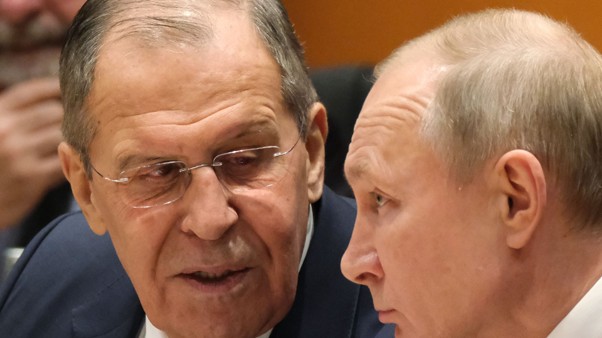
Russian President Vladimir Putin (R) and Foreign Affairs Minister (L) Sergei Lavrov [source]
Covert information activity should not be viewed in isolation from overt Russian state messaging. The two often move in parallel.
The official statements of Russian President Vladimir Putin, Foreign Minister Sergey Lavrov and Government Spokeswoman Maria Zakharova provide the authorised vocabulary of Russian foreign policy. They articulate the frames that state media, proxy outlets, sympathetic influencers and covert assets can then echo, adapt or radicalise.
Putin’s messaging often operates at the level of strategic inevitability. He presents the West as declining, Russia as resilient, sanctions as ineffective, and the global order as moving away from Western dominance. Around the G7, that line is likely to support a narrative that the summit represents an old order trying to preserve its relevance.
Lavrov’s messaging typically gives that worldview a diplomatic vocabulary. He often frames the West as violating international law, imposing illegal sanctions, weaponising institutions, destabilising global affairs and refusing to accept a multipolar world. In the context of the G7, Lavrov-style messaging is likely to emphasise coercion: the West pressuring others to follow sanctions, the G7 imposing rules without legitimacy, and Western states using Ukraine as an instrument of confrontation with Russia.
Zakharova’s messaging is often sharper, more reactive and more media-facing. Her role is well suited to ridicule, accusation and rapid exploitation of perceived hypocrisy. Around the G7, that may involve attacking summit statements, mocking Western unity, accusing France or other hosts of double standards, or using specific incidents to reinforce broader narratives about decline, censorship, Russophobia or moral collapse.
The distinction is important – overt messaging provides the frame. Covert operations provide the fog.
The official line may say that the G7 is illegitimate, divided and anti-Russian. Covert assets may then circulate a fake document suggesting a private split over Ukraine. The official line may say sanctions are failing. Proxy accounts may amplify misleading economic comparisons. The official line may say the West is censoring dissent. Fake media brands may claim that independent journalists were suppressed or that summit protests were hidden. The official line may say the Global South rejects the G7. Coordinated accounts may push selective comments from non-Western figures to create the appearance of a wider consensus.
This is how overt and covert influence can reinforce one another without needing to appear formally connected.
The Likely Narrative Package
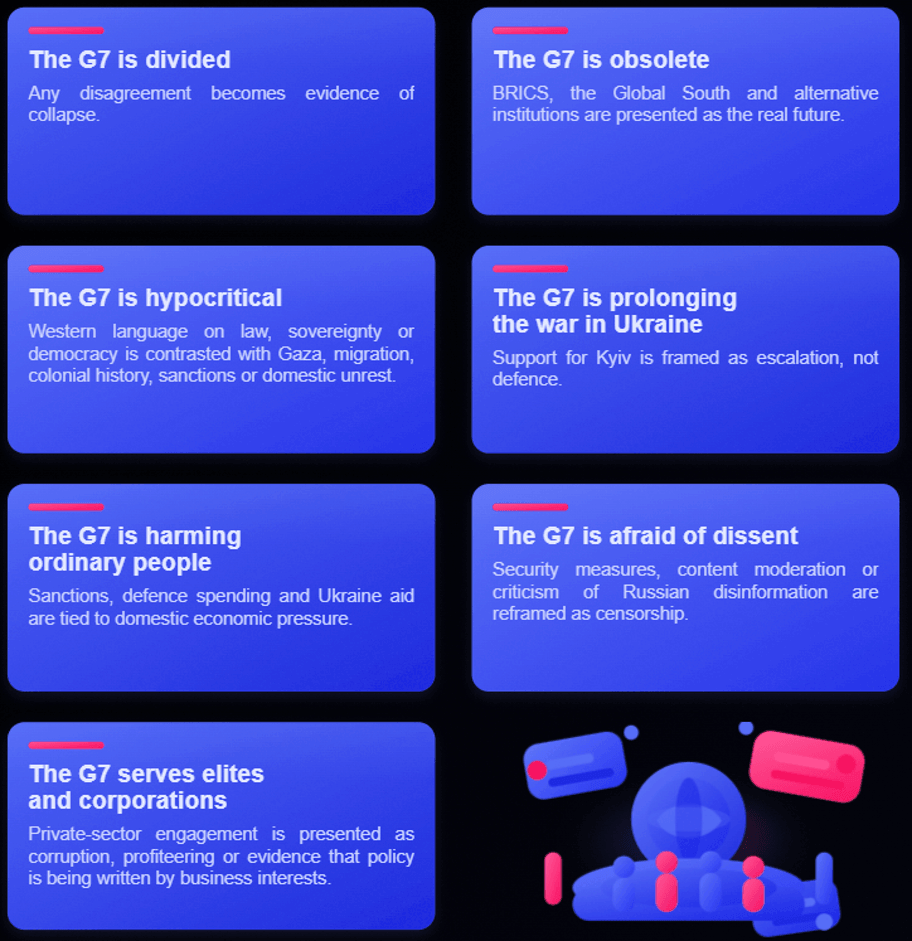
The Russian narrative package around the G7 is therefore likely to combine several mutually reinforcing claims:
These narratives are effective because they are modular. They can be adapted to different audiences, languages and platforms. A Telegram channel may use harsher anti-Western language. A fake European news site may use a more restrained tone. A social media account targeting Global South audiences may foreground colonial hypocrisy. An English-language influencer may focus on Ukraine fatigue. A state official may use diplomatic language while proxy accounts make the more inflammatory claims.
The content changes. The structure remains the same.
Potential Impacts During the Summit
Disinformation around the G7 is unlikely to change the summit agenda by itself. That is not the point.
The more realistic impact is cumulative: to distort how the summit is interpreted, to complicate public understanding, to undermine confidence in its outcomes, and to increase the political cost of alignment among G7 states. In this sense, the information operation does not need to defeat the summit. It only needs to make the summit look weaker, more divided, more hypocritical or less legitimate than it is.
One potential impact is the erosion of perceived unity. The G7 depends heavily on the optics of coordination. If Russian state and state-aligned actors can amplify the impression of division, even through selective clips, mistranslated remarks, exaggerated disagreements or fabricated leaks, they can weaken the summit’s strategic message. This is particularly relevant on Ukraine, where the appearance of allied cohesion has political and psychological value.
Another impact is the amplification of sanctions fatigue. If the summit produces new sanctions language, asset measures or commitments on enforcement, Russian narratives are likely to frame them as evidence of Western desperation. Covert activity may support this by circulating misleading economic claims, false expert commentary or selective comparisons designed to suggest that sanctions hurt Europe more than Russia. The objective is not necessarily to convince everyone. It is to make sanctions feel futile, performative or self-harming.
A third impact is pressure on Ukraine. False or distorted claims about private disagreements, conditionality, negotiating fatigue or reduced Western appetite can be used to create anxiety in Ukrainian audiences and among Ukraine’s supporters. Even if quickly corrected, these claims can contribute to a wider sense that support is unstable, transactional or quietly weakening.
A fourth impact is reputational pressure on the G7 outside the West. Narratives aimed at the Global South may present the summit as exclusionary, colonial or economically coercive. This matters because the G7 is not only speaking to its own publics. It is also competing for legitimacy in a wider international environment where Russia, China and others are seeking to frame Western power as declining and self-interested.
A fifth impact is information overload. Operations such as Matryoshka and Overload are designed not only to spread falsehoods, but to clog the verification environment. During a fast-moving summit, fabricated documents, fake articles, impersonated media brands and misleading visuals can force journalists, analysts and officials to spend time disproving claims that were never made in good faith. That diversion is itself an effect.
Finally, disinformation can create a distorted historical record of the summit. The first misleading frame often outlives the correction. A fake split, a manipulated image, a false quote or a misleading claim about the communiqué can be repeated long after the event has ended. In that sense, summit disinformation is not only about real-time disruption. It is also about narrative residue: the version of the summit that remains searchable, quotable and reusable later.
Why Monitoring Matters Before the Falsehood Peaks
Disinformation monitoring is often treated as a response function: identify the false claim, assess its reach, correct the record. That is necessary, but it is not enough.
By the time a false claim is widely visible, the narrative environment may already have shifted. The first wave of exposure often matters more than the correction. This is particularly true during major diplomatic events, where timeframes are compressed and attention moves quickly.
The value of narrative intelligence is that it does not only ask whether a claim is true or false. It asks what the claim is trying to do.
Is it trying to discredit the summit? Divide allies? Undermine Ukraine support? Exhaust journalists? Force fact-checkers to waste time? Suggest Western hypocrisy? Influence audiences outside Europe? Create ambiguity around a real policy announcement? Seed doubt before an official communiqué?
These questions matter because not every piece of hostile content is designed for virality. Some content is designed for targeting. Some is designed for laundering. Some is designed to trigger elite conversation. Some is designed to create screenshots that can be re-used later. Some is designed simply to clog the information environment.
A summit like the G7 requires monitoring before, during and after the event. Before the summit, analysts should look for pre-positioned narratives, suspicious domains, impersonation attempts, false event materials, coordinated hashtags and early references to likely agenda items. During the summit, monitoring should track narrative acceleration, manipulated media, fake quotes, hostile framing and cross-platform amplification. After the summit, attention should shift to follow-up narratives: claims that the summit failed, that Ukraine was abandoned, that sanctions collapsed, that Western unity fractured, or that the Global South rejected the outcome.
The point is not only to debunk. It is to understand trajectory.
Narrative Intelligence for Summit Risk
The G7 is a diplomatic summit, but it is also a narrative battlefield.
For Russia, the event provides an opportunity to challenge Western unity, undermine support for Ukraine, attack sanctions policy, appeal to the Global South, discredit private-sector engagement and present the liberal international order as exhausted. Some of that will be done overtly, through the official language of Putin, Lavrov and Zakharova. Some may be done covertly, through impersonation, forged content, proxy amplification and operations designed to overwhelm or confuse.
The two should be read together.
Overt messaging tells us what the Russian state wants the world to hear. Covert activity can show us where it wants that message to travel, who it wants to influence, and what it wants to obscure.
This does not mean every hostile post, fake quote or anti-G7 narrative is directed by Moscow. The information environment is messy, and major summits attract a wide range of criticism, activism, opportunism and organic debate. But that is precisely why monitoring matters. Narrative intelligence helps distinguish between ordinary criticism, coordinated amplification, state-aligned framing and operationally useful disinformation.
In that environment, the G7 is not only a meeting of governments. It is a story being contested in real time.
And hostile actors do not need to control the summit to exploit it. They only need to shape how people understand it.
{{standout}}
Threat intelligence insights, straight to your inbox
Get practical insights and expert guidance from SecAlliance.