When Executives Become Intelligence Targets: Why the G7 Matters Beyond Government
Published by:
Natasia Kalajdziovski
Published on:
June 17, 2026
Understand your whole threat landscape
SecAlliance's Fusion Team focuses on providing both conventional and cyber threat intelligence services on what matters most: protecting your C-Suite, your sites, and your reputation. Move beyond generic feeds and start using actionable intelligence that truly shapes your defence.
This article forms part of a three-part series examining the G7 through the lens of SecAlliance’s Fusion Team service lines. Each piece looks at a different dimension of summit risk: VIP and executive monitoring, narrative threat intelligence, and physical threat intelligence.
Together, the series explores how major diplomatic events create overlapping threat environments for governments, private industry and high-profile individuals. From executive exposure and intelligence collection, to hostile narratives and information manipulation, to the physical security implications of high-profile gatherings, the series demonstrates why summit risk must be understood as a fusion problem: digital, physical, geopolitical and reputational at the same time.
When people think of a G7 summit, they tend to think of presidents, prime ministers, motorcades and carefully choreographed diplomatic statements. The public image is one of statecraft: leaders around a table, negotiating communiqués on war, trade, economic security, technology, climate, organised crime and the future of global governance.
That image is accurate, but incomplete.
A G7 summit is not only a meeting of politicians and government officials. It is also a magnet for private industry. Around the official summit itself sits a wider ecosystem of business engagement, policy dialogue, sector-specific meetings, bilateral discussions, receptions, advisory groups, media events and informal networking. Executives from finance, energy, defence, technology, critical minerals, infrastructure, telecoms, logistics, pharmaceuticals, AI, investment and professional services may all have reason to be present in the host country, adjacent cities, official side events or the wider diplomatic orbit.
This matters because executives attending international summits do not arrive simply as individuals. They arrive as representatives of commercial capability, strategic access, investment intent, technical knowledge and political proximity. In the eyes of hostile states, competitors, criminals and opportunistic threat actors, that makes them valuable.
The G7 is therefore not only a diplomatic event. It is an intelligence environment.
Private Industry Is Part of the Summit Ecosystem
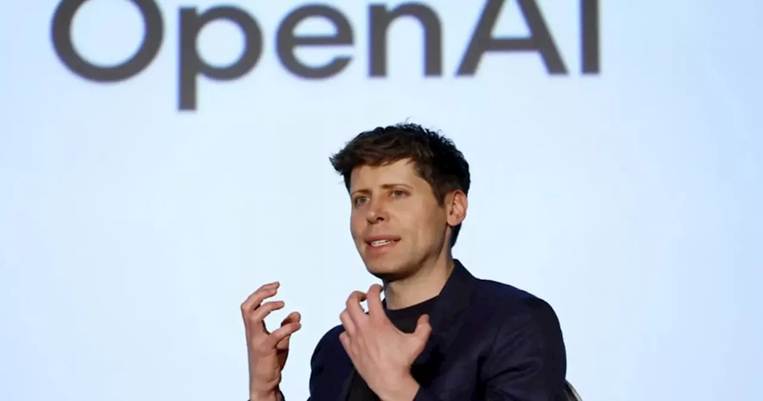
Sam Altman, CEO of OpenAI, will be attending the G7 after an invitation from French President Emmanuel Macron [source]
Modern summitry depends heavily on the private sector. Governments cannot discuss economic resilience without engaging banks, insurers, investors and major employers. They cannot talk credibly about artificial intelligence without technology companies. They cannot address energy security without energy producers, grid operators, nuclear firms, renewables developers and critical infrastructure providers. They cannot reduce dependency on hostile or unstable supply chains without input from mining, logistics, manufacturing, semiconductor and critical minerals firms.
This is particularly relevant to the 2026 G7, where France’s Presidency has placed emphasis on issues including geopolitical crises, macroeconomic imbalances, value chains, digital tools, development finance, organised crime and illegal flows. These are not abstract policy themes. They are live commercial issues. They touch the sectors that states need to court, regulate, protect, pressure or monitor.
That is why business engagement around the G7 matters. The Business 7, or B7, exists precisely because major economies recognise that industry has a role in shaping the economic agenda. Executives may not be sitting in every closed-door leaders’ session, but they are still part of the wider strategic conversation. They may attend formal business forums, bilateral meetings, embassy-hosted events, sector roundtables, investment discussions or private meetings with policymakers and advisers.
For senior executives, that proximity creates opportunity. It also creates exposure.
The Executive as a Collection Target
International summits bring together multiple states, multiple security services, multiple delegations and multiple private-sector interests in a compressed physical and digital space. For intelligence services, that concentration is valuable.
The obvious intelligence targets are government officials. However, executives can be just as attractive, particularly when they hold insight into commercially sensitive sectors or emerging policy areas. A CEO, board member, general counsel, chief technology officer, head of government affairs or regional director may have knowledge of pending investments, supply chain vulnerabilities, merger activity, sanctions exposure, regulatory lobbying, market-entry plans, technology partnerships or internal risk appetite.
That information can be useful to a state for several reasons:
· It can support economic advantage.
· It can inform sanctions evasion.
· It can help identify pressure points in strategic industries. It can reveal government thinking indirectly, especially where a company is close to policymakers.
· It can assist state-backed firms. It can help shape influence activity.
· It can identify individuals who may be cultivated, coerced, compromised or exploited later.
The important point is that executives do not need to work in defence or national security to be of interest. A renewable energy executive may hold insight into grid resilience and investment priorities. A telecoms executive may understand network dependencies. A pharmaceutical executive may know about supply chain bottlenecks. A finance executive may be aware of capital flows, sanctions risk or sovereign exposure. A technology executive may hold insight into AI deployment, data infrastructure or export controls.
At a G7 summit, those details become more valuable because they sit inside a wider geopolitical context.
States Outside the Room Are Still Watching
The G7 is, by definition, a club of advanced economies: France, the United States, the United Kingdom, Canada, Germany, Italy, Japan and the European Union. But the strategic relevance of the summit extends far beyond those present in the room.
States that are not present still have strong incentives to monitor the event. Russia will be interested in discussions on Ukraine, sanctions, energy security, reconstruction, defence production and Western cohesion. China will be interested in supply chains, technology restrictions, critical minerals, AI governance and trade alignment. Iran may be interested in sanctions, regional security, energy markets and the diplomatic positioning of G7 states. Other states may focus on development finance, debt, infrastructure, food security, migration, organised crime, climate finance or access to Western markets.
Not all collection activity will be directed at ministers. Some of it will be directed at the people around them.
Executives can provide indirect access to policy debates without the same level of protection afforded to official delegations. They may be more relaxed in hotels, restaurants, receptions, airport lounges, private cars or informal networking spaces. They may travel with fewer security layers than government officials. They may carry devices containing sensitive commercial or personal data. They may use personal phones for convenience. They may discuss sensitive matters in public or semi-public places. They may underestimate how much can be learned from observation alone.
For a hostile intelligence service, the executive may be the softer route into a harder target.
The Threat Is Not Only Cyber
It is tempting to frame executive risk at international summits as a cybersecurity problem. Cyber risk is certainly present. Executives may face spear-phishing, device compromise, malicious Wi-Fi networks, credential harvesting, fake event apps, cloned portals, QR-code lures, impersonation attempts and targeting through personal email or messaging platforms. Temporary travel environments often increase the likelihood of insecure behaviour, especially when executives are moving quickly between meetings and relying heavily on mobile devices.
But the threat is broader than cyber.
1. Physical surveillance remains a concern.
Executives attending summit-adjacent events may be observed from arrival to departure: where they stay, who they meet, what vehicles they use, whether they have security, whether they travel alone, and whether they follow predictable patterns. This is not only relevant to state actors. Criminal groups, commercial competitors, hostile insiders, investigative journalists and fixated individuals can all exploit visible routines.
2. Human intelligence approaches are also plausible.
Summits create socially permissive environments where introductions are expected. A reception, hotel bar, side event or networking dinner can provide cover for elicitation. A conversation that appears casual may be designed to test access, political views, vulnerabilities or knowledge. A request for a business card, a LinkedIn connection or a follow-up meeting can become the first stage of a longer targeting cycle.
3. There is also a reputational threat.
Executives attending politically sensitive summits can become symbols, particularly if their companies are associated with controversial sectors, government contracts, defence, fossil fuels, artificial intelligence, surveillance technology, infrastructure, sanctions, Israel-Gaza, Ukraine, labour disputes or supply chain concerns. State-aligned information operations may seek to frame companies as hypocritical, exploitative, complicit or politically compromised.
In the current information environment, a single image can travel faster than any official correction.
Digital Footprints Create Physical and Intelligence Risk
For executives, one of the most overlooked risks is the relationship between digital exposure and operational vulnerability.
A summit trip creates multiple moments where personal and corporate information can leak. Travel plans may be inferred from flight activity, hotel bookings, diary entries, social media posts, public speaking schedules, media appearances, tagged photographs, LinkedIn updates, corporate announcements or posts by colleagues and family members. Even when the executive does not post, others may reveal their location, movements or associations.
This is important because pattern-of-life data can be used operationally. Knowing where an executive is staying, what event they are attending, when they are arriving, who they are meeting, and whether they are accompanied can support surveillance, social engineering, theft, intrusion, impersonation or hostile approach.
The issue is not only whether information is public. It is whether separate pieces of information can be combined. A conference agenda, a LinkedIn post, a hotel lobby photograph, an executive assistant’s out-of-office message and a local news clip may individually seem harmless. Together, they can produce an actionable picture.
The same is true of corporate exposure. An executive’s attendance can reveal strategic intent before a company is ready to disclose it. A meeting with a minister may indicate market expansion. A photograph with a technology partner may suggest a future deal. Attendance at a closed sector roundtable may indicate lobbying priorities. A pattern of meetings across several delegations may reveal geopolitical alignment, investment appetite or dependency on particular markets.
For hostile actors, that is not background noise. It is intelligence.
This is one of the reasons executive monitoring has become increasingly important. It is not enough to assess whether an executive is “high profile” in general terms. Organisations need to understand what is visible, what is changing, who is talking about them, and how online exposure could translate into offline, commercial or intelligence risk.
The Post-Summit Risk Window
The risk does not end when the summit closes. In some cases, it becomes more acute.
During the summit itself, executives are often more alert. They know they are travelling. They know the environment is politically sensitive. They may have temporary security arrangements in place, hardened devices, controlled itineraries and heightened awareness from internal teams. Once they return home, that alertness can drop.
After a G7 summit, executives may continue to face targeting linked to the meetings they attended, the people they were photographed with, the sectors they represented, or the policy areas discussed. A hostile actor may use summit attendance as the pretext for a highly plausible follow-up: “sharing the revised communiqué,” “following up from the Paris roundtable,” “connecting after the B7 discussion,” “sending the updated attendee list,” or “circulating notes from the closed-door session.”
These lures work because they fit the context. Executives expect follow-up. They expect documents. They expect new contacts. They expect meeting requests, introductions, briefing notes, invitations and policy summaries. The summit creates a reason for strangers to get in touch and for sensitive-looking material to arrive in inboxes.
This post-event period is also when the intelligence value of the summit can be consolidated. A casual meeting becomes a LinkedIn connection. A business card becomes a direct email. A photograph becomes proof of access. A conversation becomes the basis for a longer cultivation attempt. A device compromise may not be used immediately, but held for future access. A phishing attempt may be delayed until the executive is back inside normal corporate systems.
The same applies to reputational exposure. Media coverage, hostile commentary and state-aligned narratives can continue after the summit, particularly if the event produces controversial outcomes, visible disagreements between leaders, new sanctions, defence announcements, trade measures or policy commitments. Executives and companies may be drawn into wider political narratives even if their role was limited. Their attendance may be framed as evidence of influence, alignment, hypocrisy, complicity or strategic intent.
For companies operating in sensitive sectors, this post-summit monitoring period is essential. The question is not only what happened at the event. It is what the event made visible, who noticed, and how that visibility may be used days, weeks or months later.
What Organisations Should Be Asking Before Their Executives Travel
For companies sending executives to summit-adjacent events, the key question is not simply:
“Is the location secure?”
That is too narrow. It treats the summit as a travel security problem when, in reality, it is an intelligence exposure problem.
The sharper question is:
If a hostile state, competitor, criminal actor or reputational adversary knew our executive was attending, what could they learn, exploit or do?
That question changes the risk assessment. The executive is no longer just a traveller. They are a potential collection target, a source of commercial insight, a route into the organisation, and a visible symbol of corporate positioning.
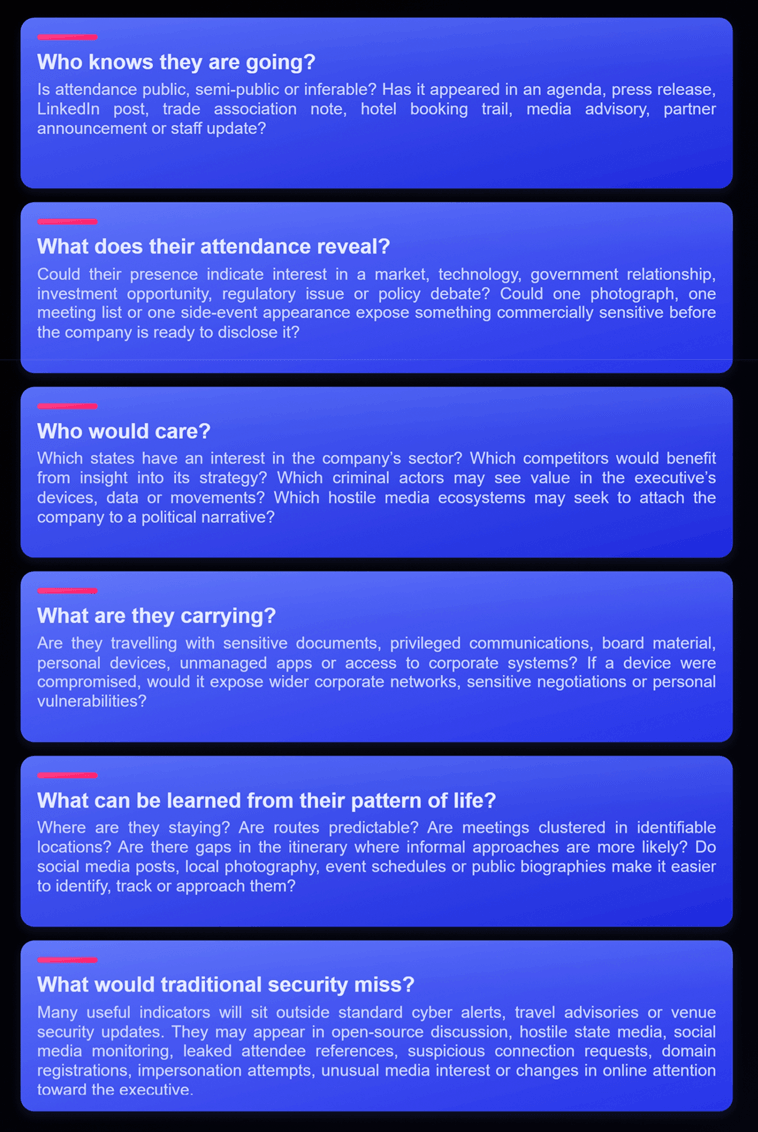
Before travel, organisations should be asking:
This is where executive monitoring becomes essential. It provides the connective tissue between cyber security, physical security, reputation, geopolitics and personal exposure. It allows organisations to understand not only whether a threat exists, but how that threat may materialise around a specific individual, in a specific place, at a specific moment.
For a senior executive attending the G7, the risk is not that they are famous.
The risk is that they are useful.
Useful because of what they know. Useful because of who they can access. Useful because of the sector they represent. Useful because of the state relationships their company depends on. Useful because their device opens a door. Useful because their public presence tells a story someone else wants to manipulate.
That is the uncomfortable reality of executive risk at international summits. The executive does not need to be the main target of the event to become a target within it.
Intelligence-Led Executive Monitoring
International summits such as the G7 concentrate power, money, policy and visibility. That makes them useful. It also makes them risky.
For executives, the threat environment is shaped by more than the official security perimeter. It includes the hotel lobby, the side event, the reception, the airport transfer, the personal device, the public photograph, the hostile media narrative, the fake follow-up email and the unknown individual who appears to know too much.
This does not mean executives should avoid attending. For many organisations, participation in summit-adjacent activity is commercially and strategically important. But it does mean attendance should be treated as an intelligence-led risk activity, not simply a diary commitment.
The G7 may be a meeting of governments, but its significance extends deep into the private sector. Where executives are close to power, policy and strategic industries, they become part of the intelligence picture.
And in that environment, visibility is not neutral. It is a vulnerability that needs to be understood, monitored and managed.
{{standout}}
Threat intelligence insights, straight to your inbox
Get practical insights and expert guidance from SecAlliance.