Eurovision 2026: Glitter, Boycotts and the Politics Behind the Banger
Published by:
Natasia Kalajdziovski
Published on:
May 19, 2026
Stay Ahead in an Emerging Threat Landscape
SecAlliance's Disinformation Monitoring and Managed Cyber Threat Intelligence services provide continuous visibility into narrative-based threats, including the detection of coordinated campaigns, early identification of emerging content targeting clients, and structured intelligence to support communications and crisis response teams. Learn how we can support your organisation.
Natasia Kalajdziovski, Senior Fusion Threat Intelligence Analyst at SecAlliance, explains how the 2026 Eurovision Song Contest became a test case for the myth of cultural neutrality, what the controversies around Israel, sponsorship, voting and Bulgaria’s surprise victory reveal about the weaponisation of pop spectacle, and why these dynamics matter for European broadcasters, policymakers, and brands.
Eurovision has always been ridiculous. That is part of its charm. The smoke machines, flag capes, key changes and inexplicable staging choices are not distractions from the contest; they are the contest. But in 2026, the glitter was doing a lot of work.
This year’s Eurovision Song Contest, held in Vienna, was not just a musical competition. It was a stress test for the idea that culture can remain politically neutral in an age of war, polarisation and reputational warfare. The European Broadcasting Union continued to frame Eurovision as a non-political cultural event. Yet almost every major controversy surrounding the 2026 contest pointed in the opposite direction: boycotts over Israel’s participation, scrutiny of sponsorship, allegations around voting campaigns, rumours about Russia’s possible future return, and questions around Bulgaria’s sudden transformation from absent participant to Eurovision winner.
Bulgaria’s DARA won the contest with “Bangaranga”, giving the country its first-ever Eurovision victory. On the surface, it was the perfect Eurovision story: a returning country, a charismatic performer, a huge pop hook, and a staging package polished enough to survive three minutes of live television chaos. But as ever with Eurovision, the surface is not the story. Bulgaria’s victory immediately raised a more interesting question: how does a country that had not participated for several years, amid repeated concerns about cost, return with a competitive package strong enough to win the whole thing?
That question matters because Eurovision is never just about the song. It is about infrastructure, money, networks, visibility and narrative control. And in 2026, all of those things sat just beneath the chorus.
The Israel Question and the Collapse of Eurovision’s Neutrality Claim
The central political controversy of Eurovision 2026 was Israel’s continued participation amid the war in Gaza. This was not new. Israel’s presence had already generated protests, petitions and artist-led criticism in previous contests. But in 2026, the debate escalated from noise around the event to a rupture inside it.
Five countries — Ireland, Spain, the Netherlands, Slovenia and Iceland — boycotted the contest over Israel’s participation, leaving the 2026 edition with 35 participating countries, the lowest number since 2004. The boycott was not a Eurovision tantrum. It was an institutional decision by national broadcasters and states to remove themselves from a shared cultural space because remaining in that space had become politically intolerable.
That matters. Participation in Eurovision is not neutral. It confers visibility, legitimacy and belonging. For Israel, the contest offered a platform to project normality, cultural confidence and European inclusion at a moment of intense international criticism. For critics, Israel’s continued participation looked like a failure to apply the same moral logic used to exclude Russia after the full-scale invasion of Ukraine.
This was the contradiction the European Broadcasting Union (EBU) could not easily solve. Eurovision wants to be above politics, but it is built around national broadcasters, national flags, national rankings and national prestige. It cannot trade on national identity for spectacle and then pretend national identity has no political meaning.
The Israel debate exposed the limits of “United by Music” as a slogan. Unity is easy when everyone agrees on the terms of belonging. It becomes much harder when the stage itself is treated as evidence of legitimacy.
Voting as an Information Integrity Problem
The second controversy was not only whether Israel should participate, but whether the voting system itself could withstand political mobilisation.
Eurovision voting has always been political. Neighbour voting, diaspora voting, and bloc voting are part of the contest's folklore. But recent concerns around Israel's public-vote strength shifted the discussion from bias to integrity.
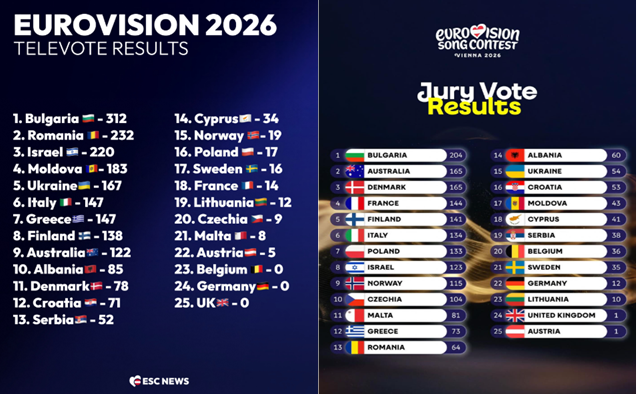
Reuters reported that the EBU introduced new voting rules for 2026 after complaints about Israel’s unusually strong public vote in 2025. Israel received 83% of its points from the public that year, compared with 41% for Austria’s winning entry. For 2026, the EBU reduced the maximum number of votes per payment route from 20 to 10 and introduced rules discouraging “disproportionate promotion campaigns.”
Fig 2 – Public vote vs televote results [source][source].
That language is very Eurovision, but the underlying issue is familiar to anyone who works on information environments. When a trusted public system becomes vulnerable to coordinated mobilisation, the result becomes less important than the perception of manipulation. It is not just who wins. It is whether people believe the system has been captured.
The EBU reportedly issued a formal warning to Israeli broadcaster KAN after videos by Israel’s 2026 entrant, Noam Bettan, instructed viewers to “vote 10 times for Israel.” KAN denied wrongdoing, but the episode showed how quickly Eurovision had moved from entertainment management into election integrity and governance.
This is where the contest becomes more interesting than the scoreboard. Eurovision is not an election, but it increasingly has election-like vulnerabilities: mass participation, emotional mobilisation, cross-border campaigning, diaspora networks, and challenges of legitimacy. Once that legitimacy is questioned, every vote becomes a narrative object.
Sponsorship and the Politics of Association
Then there is the sponsorship question.
Moroccanoil remained Eurovision’s presenting partner in 2026, with the official Eurovision website listing the brand among its partners for the contest. The company has long attracted criticism from pro-Palestinian campaigners and Eurovision fans because of its Israeli roots and business associations. In a normal entertainment context, this might have remained a niche activist complaint. In 2026, it fed directly into the contest’s central legitimacy crisis.
Fig 3 – Example of Moroccanoil sponsorship in Basel [source]
The claim circulating in some activist and fan spaces was not simply that the sponsorship was uncomfortable. It was that the sponsorship potentially made it harder for Eurovision to take a hard line on Israel’s participation. That claim should be treated carefully. There is no public evidence proving that Moroccanoil dictated or directly shaped EBU decisions on participation. But politically, perception matters.
For a contest already accused of applying inconsistent standards, the presence of a high-profile sponsor associated by critics with Israel became part of the wider problem. The issue was no longer just who performs on stage. It was who funds the stage, who benefits from the stage, and whose presence the institution is prepared to defend.
This is what happens when a cultural event becomes a reputational ecosystem. Sponsors are not background furniture. They become part of the political architecture.
Bulgaria’s Return Was Not Just a Fairytale
Bulgaria's win should have been Eurovision's escape hatch. After weeks of boycotts, protests, and institutional defensiveness, DARA gave the contest what it badly needed: a new winner, a huge chorus, a cheerful visual identity, and a story that could be packaged as joy rather than crisis.
But Bulgaria’s victory was not just a fairytale. It was also a case study in how soft power gets resourced.
Bulgaria did not participate in 2023, 2024, or 2025. Its absence was widely understood in the Eurovision world as being tied to cost and capacity. Participation is expensive; competitive participation is more expensive. A winning Eurovision package requires far more than a talented artist. It requires songwriting networks, staging expertise, choreography, promotion, broadcaster coordination, and the ability to make three minutes feel inevitable.
Fig 4 – Bulgaria’s Eurovision 2026 winner, DARA [source]
So, when Bulgaria returned and won immediately, the obvious question was not whether DARA was good enough. She was. The more interesting question was: what changed behind the scenes?
Part of the answer appears to be institutional. Bulgarian National Television (BNT) signed a cooperation agreement with PROPHON, Bulgaria’s music licensing organisation, to help structure the national selection and identify potential artists using data on the most-played Bulgarian performers across radio and television. BNT framed this as a way to create clearer and more objective criteria for selecting participants.
That does not mean PROPHON funded the entry, and it would be careless to claim that without evidence. But it does suggest Bulgaria’s return was not casual. It was organised. It involved a more deliberate connection between the national broadcaster and the domestic music industry. In Eurovision terms, that matters. Countries do not usually stumble into victory. They build pipelines.
The other part of the story is external expertise. UNITED24 Media reported that “Bangaranga” was co-written by Dimitris Kontopoulos, a Greek Eurovision songwriter associated with the so-called Eurovision “Dream Team” and with several past Russian entries, including Sergey Lazarev’s 2016 and 2019 songs and Russia’s 2014 entry by the Tolmachevy Sisters. The same report noted Kontopoulos’ previous work alongside Philipp Kirkorov, the Russian pop figure and public supporter of Vladimir Putin who had long been influential in Russia’s Eurovision campaigns.
This does not prove that Bulgaria’s entry was a Russian operation, as implied in some online interpretations of the story. It does not prove that DARA, BNT or Bulgaria acted improperly. Eurovision songwriting is international, networked and commercially promiscuous by design. The same writers, producers, choreographers and staging directors often move between countries with no ideological coherence at all. That is part of the industry.
But the optics are difficult. Russia is excluded from Eurovision. A returning Bulgaria wins with a song co-written by someone linked through previous Eurovision work to Russia’s old Eurovision machine. Videos then circulate online in which Kirkorov reportedly claims involvement in preparing Bulgaria’s staging, while UNITED24 notes that neither DARA nor BNT had publicly commented on those claims at the time of reporting.
This is not clean enough to be a scandal, but it is not harmless enough to ignore. It sits in the grey zone between entertainment industry networking, reputational contamination, and the unresolved question of whether Russian cultural influence can really be excluded from European platforms while the professional networks built before 2022 remain intact.
That is the more interesting Bulgaria story. Not “did Bulgaria deserve to win?” but “what does Bulgaria’s win reveal?” It reveals the hidden infrastructure of Eurovision: money, networks, technical expertise, reputational baggage and the difficulty of separating culture from politics once the politics becomes toxic.
The Rumour Mill is Not Background Noise
Every Eurovision season comes with rumours. Usually, they are harmless: staging leaks, jury conspiracy theories, running-order meltdowns, whispers about surprise interval acts, and accusations that someone's microphone was sabotaged because their favourite came ninth.
But in 2026, the rumour mill became unusually geopolitical.
That is partly because Eurovision itself had become more politically charged. In a lower-stakes year, Bulgaria’s return would simply have been a comeback story. In 2026, it became something closer to a forensic exercise. Fans and commentators were not just asking whether the song was good. They were asking who backed it, who wrote it, who staged it, who benefited from it, and what kind of networks sat behind it.
This is where rumour becomes analytically useful. Not because every rumour is true — most are not — but because rumours show where trust has collapsed.
The controversy around the “Bangaranga” team is a good example. Once UNITED24 reported Kontopoulos’ past work on Russian Eurovision entries and his links to Kirkorov, the story did not remain confined to songwriting credits. It became part of a wider argument about whether Russia can be kept out of Eurovision institutionally while Russian-linked cultural networks continue to circulate through the industry.
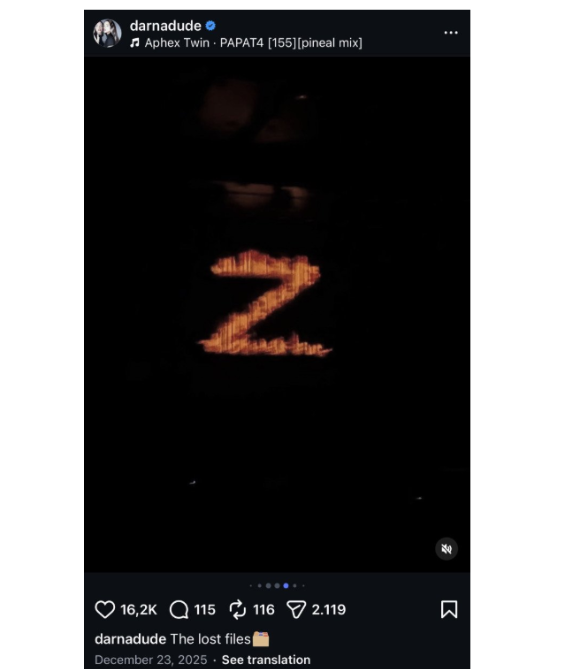
Then came the symbolism around DARA herself. UNITED24 reported that screenshots circulated online of a December 2025 Instagram post featuring a large illuminated “Z” symbol, a letter widely used as a symbol in support of Russia’s full-scale invasion of Ukraine. Context matters here. A “Z” can have multiple meanings in pop culture and staging, and screenshots circulating online should not be treated as conclusive evidence of intent. But in the current environment, symbols do not remain innocent for long. Once attached to a geopolitical frame, they become evidence in the court of online interpretation.
Fig 5 – Screenshot of DARA’s Instagram as provided by United24 Media [source]
That is precisely how malinformation works: true or partially true material can be stripped of context, reframed, amplified and weaponised. The post may or may not mean what critics claim it means. The important point is that the interpretive battle began almost immediately after DARA won.
The second major rumour cluster concerned Israel. Israel finished second, powered by strong public support, and that alone guaranteed a new round of speculation about voting campaigns, diaspora mobilisation, broadcaster conduct and whether the EBU’s rule changes were sufficient. AP reported that Israel’s second-place finish came amid allegations of extensive lobbying. Had Israel won, Eurovision 2027 would likely have entered a deeper institutional crisis. It did not win, but coming second was enough to keep the controversy alive.
The third cluster was Russia’s possible return. El País reported controversy around comments by Eurovision director Martin Green suggesting that Russia could theoretically return if the relevant broadcaster demonstrated independence from the Kremlin, though no current talks were said to be underway. In an ordinary year, this might sound procedural. In 2026, it sounded explosive.
Because this is the unresolved question hanging over the whole contest: what gets a country excluded, and what gets it readmitted?
Russia was excluded after the full-scale invasion of Ukraine. Israel was not excluded over Gaza. Bulgaria won with a song partly written by a figure linked through previous Eurovision work to Russia’s cultural machinery. Sponsors were scrutinised for perceived political association. Broadcasters withdrew over moral objection. Voting rules were tightened over fears of organised mobilisation.
None of these issues are identical. But together, they created an atmosphere in which every decision looked strategic, every partnership looked political, and every rumour found an audience already primed to believe there was more happening behind the curtain.
The rumour mill is not background noise. It is the contest’s political subconscious. It reveals what audiences think the EBU is capable of, what they think states are trying to do, and what they suspect has already happened.
In Eurovision, rumours matter because the contest runs on trust. Once trust weakens, everything becomes legible as strategy.
Eurovision Has Become Too Powerful to Pretend It Is Harmless
Eurovision 2026 exposed a deeper truth about cultural diplomacy: popular entertainment does not sit outside geopolitics. It is one of the places where geopolitics becomes emotionally legible.
States understand this. Broadcasters understand this. Protesters understand this. So do audiences. That is why participation, withdrawal, voting, sponsorship, songwriting credits and even Instagram screenshots all became politically loaded.
The EBU’s dilemma is that Eurovision’s brand depends on unity, but its format depends on difference. It asks national communities to compete, then insists the competition is above politics. That contradiction can survive in quiet years. It becomes much harder to sustain during war.
Bulgaria’s win gave Eurovision a joyful ending, but not a clean one. “Bangaranga” was a banger. It was also a reminder that culture is never just culture once the stakes are high enough.
Eurovision does not cause geopolitical conflict. But it reveals it. And in 2026, beneath the glitter, it revealed a contest struggling to manage the consequences of its own power.
{{standout}}
Sources
AP News — coverage of Eurovision 2026 boycotts, Israel controversy, Bulgaria’s win, and Sofia hosting comments
UNITED24 Media — report on DARA’s song being co-written by Dimitris Kontopoulos, his past links to Russian Eurovision entries / Philipp Kirkorov, and related online controversy