Anti-G7 2026 Mobilisation: an Assessment around Patterns of a Long-Standing Activist Threat Landscape
Published by:
Céline Clément
Published on:
June 15, 2026
Actionable threat intelligence
SecAlliance’s cyber threat intelligence services focus on what matters: mapping threats to your environment, prioritising real risks, and giving your teams concrete actions to take. Move beyond generic feeds and start using intelligence that truly shapes your defence.
This article forms part of a three-part series examining the G7 through the lens of SecAlliance’s Fusion Team service lines. Each piece looks at a different dimension of summit risk: VIP and executive monitoring, narrative threat intelligence, and physical threat intelligence.
Together, the series explores how major diplomatic events create overlapping threat environments for governments, private industry and high-profile individuals. From executive exposure and intelligence collection, to hostile narratives and information manipulation, to the physical security implications of high-profile gatherings, the series demonstrates why summit risk must be understood as a fusion problem: digital, physical, geopolitical and reputational at the same time.
The G7 takes place in Evian, France from 15 to 17 June 2026 and brings together representatives of Germany, Canada, the United States, France, Italy, Japan and the United Kingdom. The European Union has also been fully associated with it since 1977. This forum was held for the first time in 1975, when the first oil shock revealed the need for enhanced international economic cooperation.
Member countries meet periodically to address economic, environmental or security issues in order to open a dialogue on major global imbalances.
Nevertheless, the G7 has no legal existence, no permanent secretariat, and no membership in law [source].
To some extent, it is what could be described as yet another club of the powerful without a decision-making institution. The scope is therefore informal, diplomatic, or even symbolic. During a G7 summit, the contemporary issues raised, the political agenda or the selected guests represent a relative and symbolic reading of the geopolitical world through the eyes of the protagonists.
But, the controversy surrounding it gives us clues about the militant and activist landscape – in this case in Europe because the summit is held in France, not far from the Swiss border.
Anti-G7/G8 Historical Protests
The beginning of anti-G7 or G8 protests dates back to the 1990s and is rooted in an anti-neoliberal and alter-globalisation (Internationalism) ideology. Marx and Engels's concept of internationalism emphasises the unity of the global proletariat in the struggle against capitalism, advocating for solidarity across national boundaries. It is within this Marxist logic that citizens mobilised, for example, against the G7 in Lyon, France in 1996; in 2001 in Genoa, Italy, in 2003 in Evian, France, and in Heiligendamm, Germany in 2007 against the G8 [source][source].
These examples before the 2008 crisis represented the high point of the European alter-globalisation movement. These protests gathered tens or even hundreds of thousands of participants, ranging from trade unions, NGOs and student organisations to anarchists, autonomous and anti-capitalist groups from across Europe and beyond.
Demonstrations were therefore designed not only to protest specific socio-economic policies, but to challenge the legitimacy of the global economic order itself. While the majority of participants engaged in peaceful marches, forums and acts of civil disobedience, a minority adopted confrontational tactics such as property destruction, barricades and clashes with police, particularly within Black Bloc movements.
Violence became highly mediatised, especially after the 2001 Genoa G8 Summit. Large parts of Genoa were transformed into militarised “red zones” – daily life, transport and businesses were heavily impacted. The death of a militant and police brutality tarnished the image of the summit [source][source].
G7 2026: A Second Summit in Evian
The 2026 G7 Summit is the second to be held at the Royal Hotel in Evian-les-Bains, France. The first summit was held in 2003, and took place in a highly tense international context, only two years after he traumatic 2001 Genoa G8 protests and shortly after the beginning of the Iraq War, which had reignited anti-imperialist and anti-American sentiment across Europe.
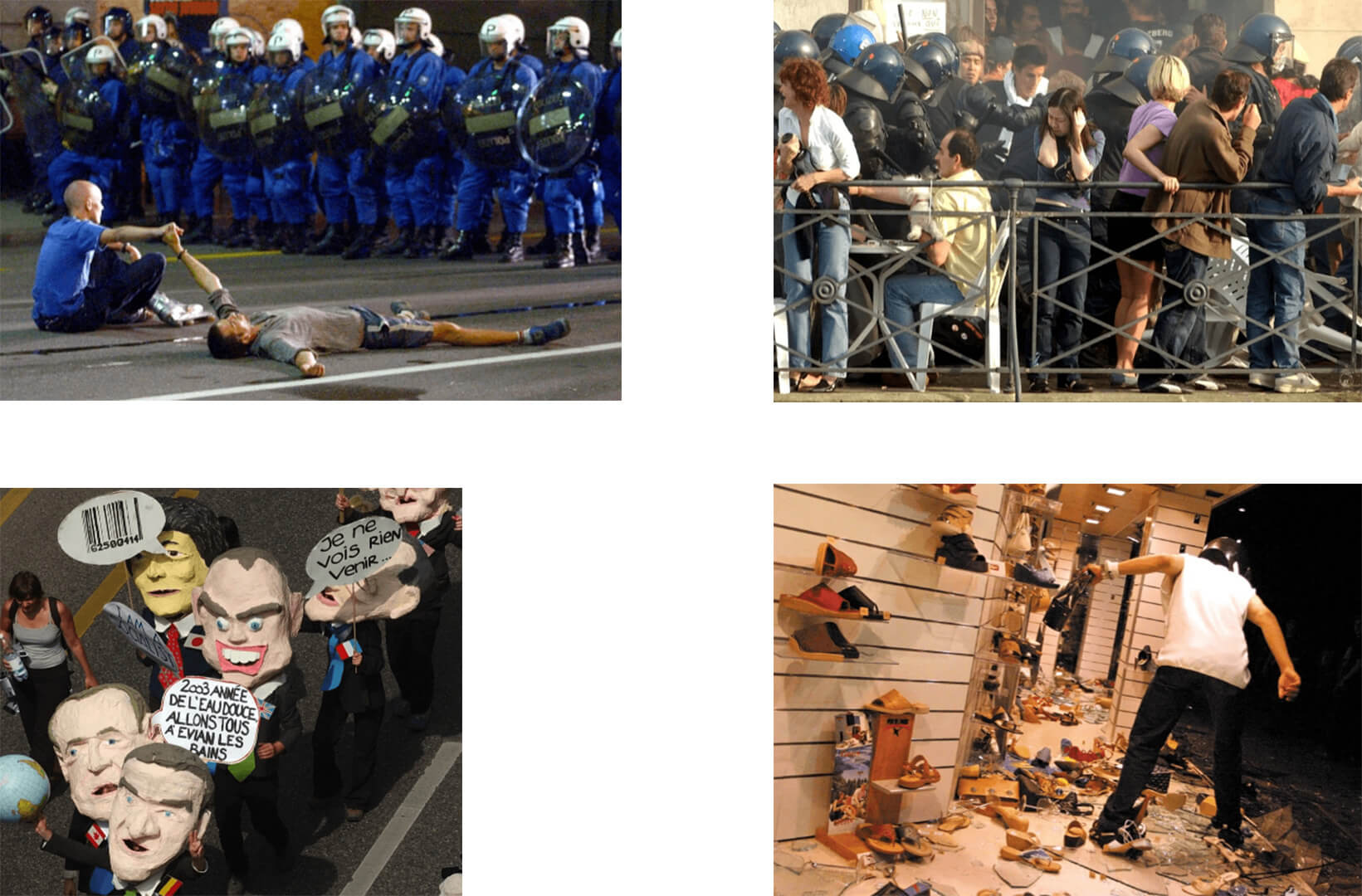
It became one of the largest anti-G8 mobilisations, because it brought together roughly 80,000 and 150,000 protesters gathered across the French-Swiss border region. Actions ranged from large peaceful marches, political forums and activist camps to road blockades, attempts to disrupt access routes, vandalism acts and sporadic clashes with police in Geneva and Lausanne. The most violent clashes were reportedly carried out by Black Bloc members [source][source][source].
Archive pictures of the mobilisation and actions carried out during the No-2003 G8 summit in Evian [source].
And What If History Repeats Itself?
Indeed, in 2026, the No G7 coalition has emerged on both the French and Swiss sides, bringing together about 60 groups such as ATTAC, trade unions (CGT branches), student unions, anti-capitalist and anti-fascist network, pro-Palestine and pro-Iran groups, climate activists, feminists and LGBTQ+ groups [source]. The counter-summit is organised online via social media platforms and a website, as well as through in-person meetings within activist circles [source][source][source].
The main struggle with authorities had been over the right to demonstrate and the protest route in Geneva for the mobilisation scheduled on 14 June 2026. Campsites will be available for protesters, but the exact locations of those were still unconfirmed a few days before the start of the protest, as several places refused to host them in fear of major disruptions and damage [source].
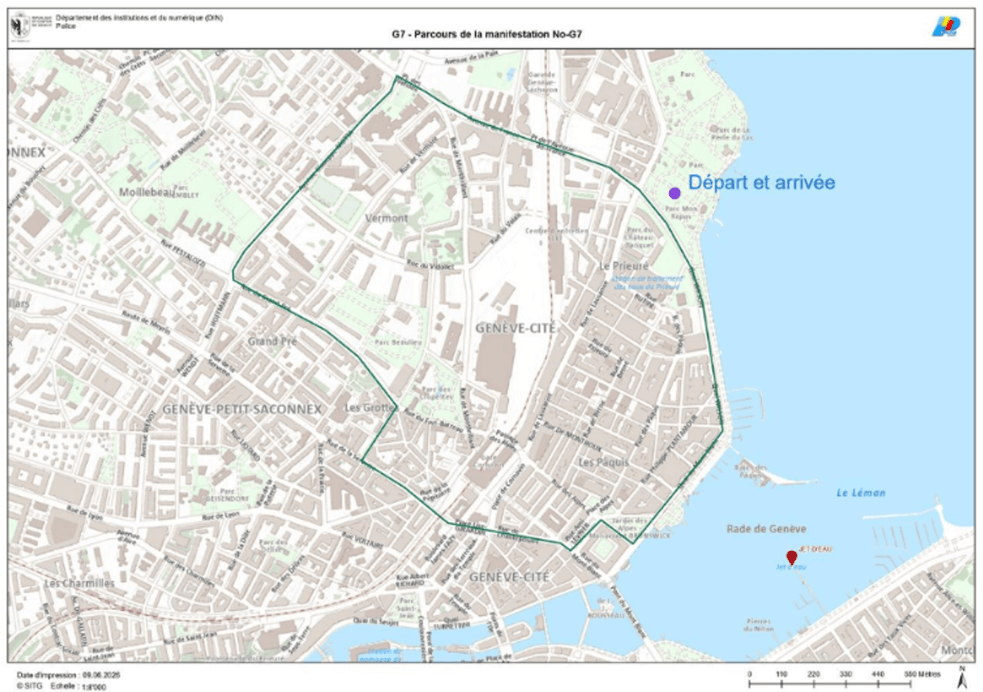
After bitter discussions, the canton and the No-G7 coalition have managed to agree on a route for the 14-June demonstration, with a starting point from Perle du Lac Park, Rue de Lausanne 120B, 1202 Genève, Switzerland, at 1400 CEST [source].
The route will be as follows, from 1500 CEST: Parc Mon Repos, Quai Wilson, Quai du Mont-Blanc, Rue des Alpes, Rue Ami-Lévrier, Rue du Mont-Blanc, Rue Chantepoulet, Place Lise-Girardin, Rue de la Servette, Rue Louis-Favre, Rue du Grand-Pré, Av. Giuseppe-Motta, Place des Nations, Avenue de France, Parc Mon Repos (finish) [source].
Route of the planned protest in Geneva, Switzerland on 14 June 2026 [source].
The Feminist Strike bloc will take the lead in the procession. Several blocs of organisations will follow, including a Palestine bloc, a bloc for people with reduced mobility, and the bloc "The living that defends itself", in which the Movement for Peasant and Citizen Agriculture will participate. The latter is presented as a "colourful and festive" bloc, "kids and family friendly", with music, a float and costumes [source].
The official opening and presentation of the No-G7 counter-summit will be held on 12 June at 1830 CEST, at the Faubourg Community Hall, Rue des Terreaux-du-Temple 6/8, 1201 Genève, Switzerland. At the same day and time and thus until 2200 CEST, a “Critical Mass NoG7” spontaneous protest will be held from Place des Grottes, 1201 Geneva to L’Usine, Pl. des Volontaires 4, 1204 Geneva, Switzerland [source].
Throughout the weekend, "international meetings" will then be organised by the coalition's member organisations. The discussions will be structured around four thematic axes: anti-imperialist, anti-colonial and anti-racist struggles; feminist and queer struggles; ecological and anti-capitalist struggles; and the anti-fascist struggles. The programme is expected to continue until 17 June, the end date of the G7.
Another sit-in mobilisation linked to the opposition of the construction of the road A412 will be taking place from 08 June to 21 June at Chab'Zad, 74200 Allinges, France. It is labelled as part of the No G7 coalition as A412 is located between Thonon-les-bains and Machilly, 15 km from the G7 in Evian-les-bains [source].
The movement’s communication focuses on following Marxist struggle logics and directly claims itself as “résistance internationaliste” (EN: alter-globalisation resistance) [source]. However, the movement is more fragmented and less ideologically unified than the alter-globalisation peak of the early 2000s. Indeed, the intersectionality of struggles, the rise of digitally mediated mobilisation, transnational solidarity movements, diverse moral considerations play a critical role into re-shaping the political activism threat landscape. While these factors lower entry barriers, they also encourage flexible forms of participation.
In addition, the goal of activism can differ from an organisation to another, while being part of the same protest. Actions can either be primarily oriented toward influencing decision makers and achieving instrumental change, or toward expressing identities, values, and idealised social and political arrangements. As a result, spontaneous actions and participation as well as diversity of tactics, outside of the official line of the organisers remain possible [source].
Assessment and Likely Disruptions
Thanks to this analysis of the context and patterns around protest and activism threat landscape at the G7, intelligence can be fed through a nuanced assessment, following the probability yardstick framework [source].
Thus, it is assessed that due to the broad spectrum of organisations involved, attendance will likely be between 10,000 and 50,000 protesters marching with anti-G7 and anti-imperialist banners and placards.
However, it is unlikely to be at the level of attendance of the anti-G8 protest in Evian, France in 2003, because of the change in the alter-globalisation activism threat landscape in Europe, as explained in this report.
The protest march on 14 June 2026 in Geneva will highly likely be the main action with the most attendance, as the call-to-action on social media was relayed by a majority of groups and media outlets. It is likely to be rather peaceful with theatrical actions, music and family in attendance. In addition, geopolitically-motivated actors will highly likely join the protests (Pro-Palestine / Pro-Iran protesters) as intended, giving an emotive nature to the protests, which could lead to more disruptive actions such as localised clashes with police.
The variety of actions and events organised across the border region by different activist groups spreads out the effort being made and, to some extent, allows the participation of more extreme activists, or troublemakers, and opportunistic actors who create more chaos. Therefore, there is a realistic possibility that extremists will join such as members of the Black Bloc movement, typically conducting violent acts against police officers. Also, acts of vandalism on companies or shops’ facades remain likely.
At the margins, other protests planned in the region will likely be held with less attendance and intensity, due to the specificity of the protest such as the anti-A412 sit-in protest actions or feminist strikes.
These planned disruptions are highly likely going to affect negatively any people travelling along the France-Swiss border due to traffic jam, transport disruptions, reinforced border controls and possible road blockades, which could result in major business continuity disruptions for companies based in the area of the protest.
{{standout}}
Threat intelligence insights, straight to your inbox
Get practical insights and expert guidance from SecAlliance.